
Notes on Resilience & Aligned Living
Reflections on clarity, capacity, transition, and building systems — personal and professional — that don’t collapse under pressure.
This is where lived experience meets structured resilience thinking.
Where I connect the dots between:
• Corporate resilience
• Personal capacity
• Burnout and rebuilding
• Structure and softness
• Designing a life that works anywhere
Because resilience is not theoretical. It is lived.
While my advisory work strengthens organizations behind the scenes, this space holds the human side of resilience.
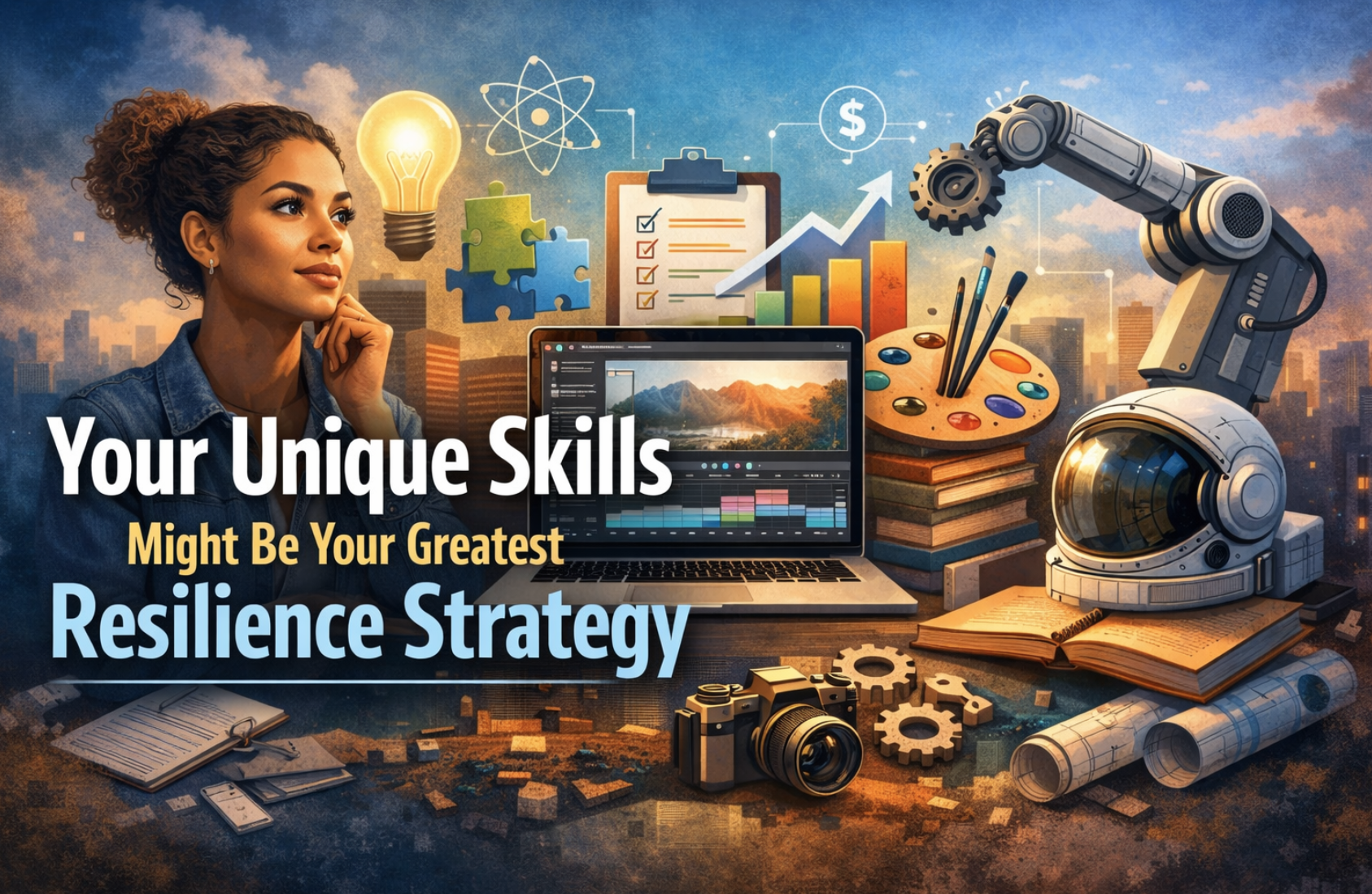
Your Unique Skills Might Be Your Greatest Resilience Strategy
Resilience is not just about toughness. It is about range. The unique skills you have picked up across your life — the ones that never quite fit one job description — may be your most powerful resilience strategy yet.
Here is a quiet misconception about resilience that is worth addressing.
Most people think resilience is about toughness. About gritting your teeth and pushing through. About being the person who never breaks.
But real resilience is rarely about toughness alone.
More often it comes from something much more practical — range.
The more ways you can think, adapt, and contribute, the more resilient your life becomes. And this is where something important often gets overlooked.
Your unique skills are not just interesting. They may be your most powerful resilience strategy.
Not Just Your Profession — Everything You Have Picked Up Along the Way
Think beyond your job title for a moment.
Think about the things you learned out of pure curiosity. The hobbies you developed without ever thinking about monetizing them. The talents that never quite fit neatly into one job description but kept showing up anyway.
Those skills matter more than most people realize.
They are not random. They are not unrelated. Together they form a collection of capabilities that makes you adaptable in ways a single specialty never could.
And in uncertain times — economically, professionally, personally — adaptability is everything.
"When your identity depends on only one role or one skill set, change becomes threatening. When you have range, change becomes something you can navigate."
Why Range Creates Resilience
People who can combine multiple capabilities adapt faster. It is not a coincidence — it is how resilience actually works in practice.
Someone who understands technology and communication can move between industries without starting from scratch.
Someone who can analyze systems and explain them clearly becomes valuable in almost any organization.
Someone with creative ability and strategic thinking can build opportunities where none existed before.
This is sometimes called skill stacking. But at a deeper level it is really about resilience.
In Business Continuity and Disaster Recovery, we build redundancy into systems on purpose. No single point of failure. Multiple pathways to the same outcome. When one route closes another is already available.
Your skill range works the same way. When change comes — and it always does — range is what allows you to pivot instead of collapse. You do not have to start over. You move sideways, forward, diagonally — because you have more than one direction available to you.
Options are one of the strongest forms of resilience you can build.
The Most Valuable People Are Rarely the Ones With One Deep Specialty
They are the ones who can connect multiple disciplines in a way others cannot.
Someone who understands operations and strategy can identify risks others overlook entirely.
Someone with creative ability and business awareness can see opportunities others never considered.
Someone who bridges communication and technical knowledge becomes the person every room needs.
Resilience often lives in the intersection of skills — not at the top of one single ladder.
The things that once felt unrelated may eventually become the most distinctive thing about you. The combination that nobody else has. The perspective that only comes from having lived and learned across more than one lane.
"Resilience often lives in the intersection of skills — not at the top of one single ladder."
Adaptability Is the Real Advantage
Resilience is not only about endurance. It is also about adaptability.
And adaptability almost always comes from the range of capabilities built over time — not just the depth of one.
The hobbies. The side interests. The skills that felt like detours. None of that was wasted.
Together they created something powerful. They created options.
And a life with options is a life that can absorb change without breaking.
A Reflection for You
What skills have you developed outside of your main career — and are you giving them credit?
What problems do people consistently ask for your help with, even informally?
What abilities feel natural to you but genuinely valuable to others?
What combinations of skills make your perspective different from everyone else in the room?
Your resilience strategy may already be present in the skills you have been quietly developing all along. You just have not called it that yet.
Your unique skills may not follow a traditional path. They may not fit neatly into one job title or one lane.
But together — the curiosity, the range, the seemingly unrelated capabilities — they create something that a single specialty never could.
They create flexibility. They create options. They create a life that does not depend on everything staying the same to stay intact.
That is not a detour. That is your strategy.