
Notes on Resilience & Aligned Living
Reflections on clarity, capacity, transition, and building systems — personal and professional — that don’t collapse under pressure.
This is where lived experience meets structured resilience thinking.
Where I connect the dots between:
• Corporate resilience
• Personal capacity
• Burnout and rebuilding
• Structure and softness
• Designing a life that works anywhere
Because resilience is not theoretical. It is lived.
While my advisory work strengthens organizations behind the scenes, this space holds the human side of resilience.
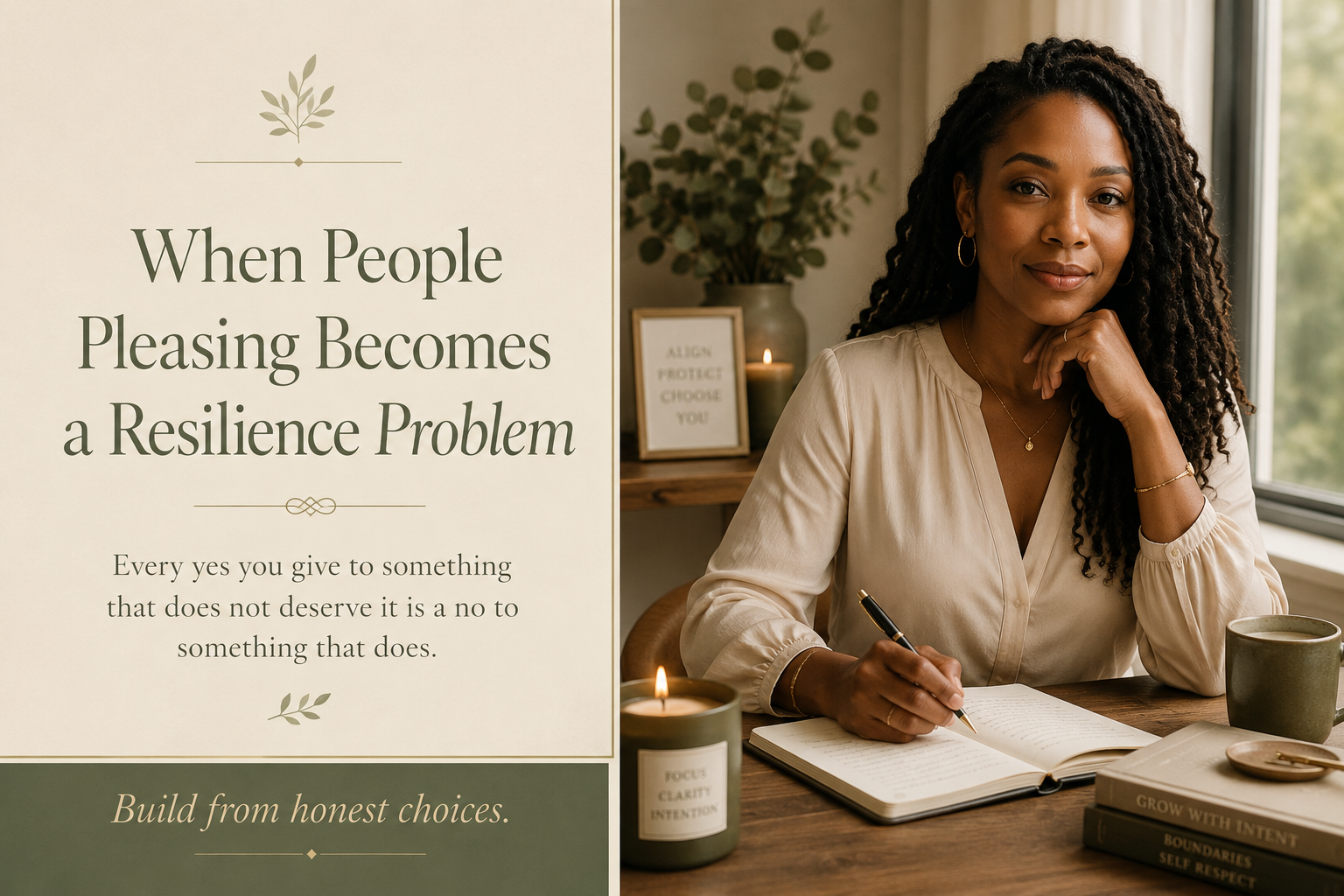
When People Pleasing Becomes a Resilience Problem
People pleasing feels like the generous choice in the moment. But over time it becomes one of the most expensive habits you can carry — not just emotionally, but structurally. Here is what it is really costing you.
Most conversations about people pleasing focus on boundaries and self worth.
And those things matter.
But there is another layer to this conversation that does not get talked about enough.
People pleasing is not just an emotional pattern. Over time it becomes a capacity problem. A resilience problem. A design problem.
Because every time you agree to something that is not aligned with what you actually want — every time you say yes to keep the peace, to avoid disappointing someone, to smooth over a moment of discomfort — you are making a withdrawal from a resource that does not replenish on its own.
And eventually the account runs dry.
What People Pleasing Actually Costs
It is easy to think of people pleasing as harmless. Polite even. The path of least resistance.
But look at what it actually requires.
It requires you to override your own instincts. To silence the part of you that knows what you want and replace it with what you think someone else needs to hear. To spend energy managing other people's reactions instead of building your own life.
That is not a small cost. That is a significant and ongoing drain on your capacity.
And unlike physical exhaustion — which is visible and easy to name — this kind of depletion is quiet. It builds slowly. It hides behind helpfulness and agreeableness and being the person everyone can count on.
Until one day you realize you have built a life full of other people's preferences and almost none of your own.
"Every time you agree to something that is not aligned with what you want, you are making a withdrawal from a resource that does not replenish on its own."
In Systems Thinking We Call This a Single Point of Failure
In Business Continuity and Disaster Recovery, a single point of failure is any place in a system where too much depends on one resource — one person, one process, one decision — with no backup and no redundancy.
When that single point fails, everything downstream fails with it.
Chronic people pleasing creates a single point of failure in your life.
Your decisions become dependent on other people's approval. Your sense of direction becomes dependent on what others want from you. Your capacity becomes dependent on having enough left over after everyone else's needs are met.
That is not a resilient system. That is a system designed to collapse under pressure.
And the pressure always comes.
Being Firm on What You Want Is Not Selfishness — It Is Design
There is a difference between being selfish and being clear.
Selfish is taking without regard for others. Clear is knowing what you need and being honest about it — even when it disappoints someone, even when it creates a moment of discomfort, even when it means holding a position that nobody else in the room agrees with.
Clarity is not unkind. It is actually one of the most respectful things you can offer the people around you.
Because when you are clear about what you want — when you stop agreeing to things you do not mean — the people in your life get the real version of you. Not the performed version. Not the version that is quietly resentful and slowly depleting. The real one.
And a relationship built on your honest yes is always stronger than one built on a yes you never meant.
The Strain Nobody Talks About
When you agree to something that is not aligned with what you want, the work does not stop at the agreement.
You still have to show up for it. You still have to deliver on it. You still have to manage the internal resistance every single time.
That resistance has a cost. Not just in time and energy — but in the quiet strain it puts on your nervous system, your relationships, and your sense of self.
Over time that strain accumulates. It shows up as irritability you cannot explain. Fatigue that rest does not fix. A growing distance between who you are performing and who you actually are.
In systems terms this is called operating under sustained load without adequate recovery. And systems that operate that way for long enough do not just slow down.
They fail.
"A relationship built on your honest yes is always stronger than one built on a yes you never meant."
What Firmness Actually Looks Like
Being firm on what you want does not mean being rigid or unkind. It does not mean never compromising or never considering others.
It means knowing your own direction clearly enough that you can tell the difference between a genuine choice and an appeasement.
It means being willing to sit in the discomfort of someone else's disappointment without immediately trying to fix it by abandoning your own position.
It means trusting that the people worth keeping in your life can handle your honest no — and that the ones who cannot are showing you something important.
Firmness is not a wall. It is a foundation. And a life built on a foundation of honest choices is a life that does not require constant recovery from the strain of living inauthentically.
A Reflection for You
Where in your life are you agreeing to things that are not aligned with what you actually want?
What decisions have you made recently to keep the peace — and what did that cost you in energy, time, or quiet resentment?
What would you do differently if you trusted that the people who matter could handle your honest answer?
Where is people pleasing showing up as a capacity drain in your life right now?
People pleasing feels like the generous choice in the moment.
But over time it becomes one of the most expensive habits you can carry.
Not just emotionally. But structurally. In the way your life gets designed. In the way your capacity gets allocated. In the distance that grows between the life you are living and the life you actually want.
Being firm on what you want is not about being difficult.
It is about being honest enough with yourself — and with others — to build something real.
And something real is always worth the temporary discomfort it takes to choose it.
— Nikki

The Long Game: How to Build Skills Today for a Life You Cannot Fully See Yet
There is a particular kind of discomfort that comes from building something you cannot fully see yet. That discomfort is not a warning sign. It is what the long game feels like from the inside.
There is a particular kind of discomfort that comes from building something you cannot fully see yet.
You are adding skills. Taking courses. Earning certifications. Saying yes to opportunities that do not quite connect — at least not on the surface. And somewhere in the back of your mind a quiet voice asks whether any of it is actually leading somewhere.
That discomfort is not a warning sign.
It is what the long game feels like from the inside.
You Do Not Need a Clear Destination to Start Building
One of the biggest reasons people delay investing in themselves is because they cannot see the full picture yet.
They do not know exactly what they want. They are not sure which direction they are heading. They are waiting for clarity before they commit to building anything.
But clarity rarely comes before the building. It comes during it.
The skills you develop today — even the ones that feel uncertain or loosely connected — are creating options for a version of your life you cannot fully see yet. And options are what make a life resilient.
You do not need to know the destination to start preparing for the journey.
"Clarity rarely comes before the building. It comes during it."
In Business Continuity We Build Before the Crisis
In Business Continuity and Disaster Recovery, one of the core principles is this — you do not wait for disruption to build your recovery plan.
You build it before anything goes wrong. You identify what you would need. You develop the capabilities that allow you to recover quickly. You create redundancy and options before they are urgently needed.
That same principle applies to your life.
Building skills today — before you desperately need them, before the market shifts, before life changes in ways you did not plan for — is not overpreparation.
It is strategic resilience.
The people who navigate disruption most effectively are almost never the ones who started preparing after things changed. They are the ones who were already building.
Skills Compound the Same Way Interest Does
There is something that happens when you commit to building consistently over time.
The skills stack. They connect. They start to create combinations that nobody else has — because nobody else has lived your specific journey or made your specific choices about what to develop.
A skill you build today may not be immediately useful. It may sit quietly in the background for months or even years before it becomes exactly what a moment requires.
But it is never wasted.
Every capability you develop adds to the ecosystem of who you are becoming. And ecosystems — unlike single streams — can survive almost anything.
What the Long Game Actually Looks Like
It does not look dramatic. It rarely feels significant in the moment.
It looks like reading in an area outside your current role because something about it interests you.
It looks like taking a course not because it is immediately required but because it expands how you think.
It looks like volunteering for the project that stretches you even when it would be easier to stay comfortable.
It looks like writing, creating, building something — even when the audience is small and the return is not yet visible.
It looks like developing your communication, your emotional intelligence, your ability to think across disciplines — not because someone asked you to but because you understand that range creates resilience.
None of those things feel like a long game in the moment. They feel like small choices.
But small choices made consistently over time become the foundation of a life that can absorb almost anything.
"The skills you build before you need them are the ones that give you options when everything changes."
Stop Waiting for the Vision to Be Complete
The vision you have today is incomplete by design. It is supposed to be. Because the version of you that will inhabit that future life is still being shaped by everything you are doing right now.
The clearer you get on your values — what matters, what aligns, what sustains you — the more naturally your skill building will point in the right direction.
You do not need the full map. You need the next right layer.
What skill, if developed consistently over the next six months, would give you more options?
What capability, if built quietly and steadily, would make you harder to disrupt?
What area of growth, if invested in now, would the future version of you be grateful for?
Start there. The picture will fill in as you build.
The Skills Nobody Can Take From You
There is a particular kind of security that comes from skills that are portable, internal, and not dependent on any single employer, industry, or system.
The ability to think critically and solve problems under pressure.
The ability to communicate clearly across different audiences.
The ability to learn quickly when conditions change.
The ability to lead — yourself first, and then others.
The ability to build something from nothing when the opportunity presents itself.
These are not narrow skills tied to one role or one organization. They travel with you. They apply across contexts. They become more valuable over time, not less.
Building them is not just professional development. It is personal infrastructure.
A Reflection for You
What skill have you been meaning to develop but keep waiting for the right time to start?
What capability, if you had it today, would give you more confidence about the future?
What are you genuinely curious about — not just strategically curious — that might be worth following?
Where are you playing it safe in your development when you could be building range?
Playing the long game is not about having all the answers today.
It is about making consistent investments in yourself — quietly, steadily, intentionally — before life demands that you have them.
The life you cannot fully see yet is being shaped right now. Not by what you are waiting for. By what you are building.
Start building.
— Nikki

Stop Forcing the Fit — A Aligned Life Is a Peaceful One
There is a kind of exhaustion that has nothing to do with how busy you are. It is the exhaustion of living out of alignment. This post is about what it looks like to finally stop forcing the fit — and build a life that actually feels like yours.
There is a kind of exhaustion that has nothing to do with how busy you are.
It is the exhaustion of living out of alignment.
Of spending your days in environments that do not fit. Saying yes to things that do not reflect who you are. Measuring your life against someone else's and wondering why yours feels like it is missing something.
That feeling is not a sign that something is wrong with you.
It is a sign that something around you needs to change.
Start With What Actually Has Value to You
Not what looks impressive. Not what other people think you should want. Not the version of success that gets the most likes or the most admiration in the room.
What actually has value to you.
This is where alignment begins — not with a plan or a strategy, but with an honest conversation with yourself about what matters and what does not.
When you get clear on what has value, something shifts. You stop filling your life with things that look good and start filling it with things that feel true.
Your calendar starts to reflect your actual priorities. Your energy goes toward what genuinely sustains you. And the things that were draining you quietly — the commitments, the environments, the relationships — start to become visible for what they are.
Deciding what has value is not a small thing. It is the foundation everything else gets built on.
"Peace does not come from having everything figured out. It comes from knowing yourself well enough to stop pretending."
Stop Forcing What No Longer Fits
There is a version of you that made certain choices — joined certain groups, pursued certain goals, built certain habits — based on who you were at the time.
And that version of you was doing the best they could with what they knew.
But growth does not freeze just because the decisions were already made.
Sometimes you outgrow environments. Sometimes you outgrow goals. Sometimes you outgrow the version of yourself that needed a certain kind of validation or belonging.
And when that happens the most honest thing you can do is stop forcing the fit.
Forcing what is not aligned is not loyalty. It is not commitment. It is not strength.
It is the slow erosion of the truest version of yourself — the one you are still becoming.
You Are Not Who You Were — And That Is the Point
Alignment is not a fixed destination. It is a living, shifting relationship between who you are today and how you are choosing to live.
The question worth asking regularly is not who you used to be or who others expect you to be.
It is who you are right now — and where you are aligning yourself to be your highest self.
That question changes things. It gives you permission to let go of what no longer serves the person you are growing into. It reminds you that changing direction is not failure — it is discernment.
And discernment only comes from knowing yourself well enough to tell the difference between what fits and what you have just gotten used to.
Peace Comes From Knowing Yourself
Real peace — the kind that does not depend on everything going right — comes from one place.
Knowing yourself. And being true to that.
Not the version of yourself that performs for approval. Not the version that shrinks to fit the room. Not the version that keeps showing up to environments that require you to be less than you are.
The version that knows what matters. That knows what aligns. That knows when something feels off — and trusts that feeling enough to do something about it.
That kind of self knowledge is not built overnight. It is built in the quiet moments. The honest ones. The ones where you stop long enough to actually hear yourself.
And when you have it — when you know yourself clearly — the noise of comparison, expectation, and external pressure loses most of its power.
"There is only one you. And you are the only one in charge of shaping what that life looks like."
Stop Comparing Your Life to Someone Else's
Comparison is one of the quietest ways we abandon ourselves.
It pulls attention away from your own path and fixes it on someone else's. It measures your behind the scenes against their highlight reel. It whispers that you are behind, that you are less than, that you should be further along by now.
But here is what comparison always misses.
There is only one you. With your specific combination of experiences, values, gifts, and vision. Nobody else is building what you are building. Nobody else is walking the path you are walking.
Your life does not need to look like anyone else's to be valid. It does not need to follow someone else's timeline to be meaningful. It does not need external comparison to determine its worth.
You are the one in charge of shaping what your life looks like. That is not a burden. That is one of the most powerful things you have.
If the Environment Does Not Fit — Change It
Sometimes alignment requires an external shift.
Not every environment is designed to support who you are becoming. Some spaces were built for a version of you that no longer exists. Some groups, some circles, some towns — they made sense at one point. They no longer do.
And that is okay.
Changing your environment is not running away. It is not being difficult. It is not ingratitude.
It is one of the most honest acts of self respect available to you.
Sometimes the change looks like no longer attending the group meetup that drains you every time. Sometimes it looks like stepping back from a circle that requires you to perform instead of belong. And sometimes — when your spirit has been quietly asking for it for longer than you want to admit — it looks like moving to a place that actually aligns with who you are.
Only you know which change is needed. Only you can hear that signal clearly enough to act on it.
A Reflection for You
What in your life right now actually has value to you — and what are you holding onto out of habit or expectation?
Where are you forcing a fit that stopped feeling right a long time ago?
What environment, group, or commitment has been quietly draining you — and what would it feel like to let it go?
What does your highest self look like — and how much of your daily life is actually aligned with that version of you?
Alignment is not a luxury. It is not something to figure out after everything else is handled.
It is the work.
Because a life built around what actually has value — around who you actually are, not who you have been performing — is a life that does not require constant recovery.
It is a life that feels like yours.
And that kind of peace is worth every honest, uncomfortable, necessary choice it takes to get there.

You Already Have More Than You Think — Stop Looking Past It
Most people are not behind. Most people are not lacking. They are simply not counting what they have already built. Before you reach for what is next, it is time to take an honest inventory of what you already have.
What happens when you stop looking for what is next and finally account for what you already built.
Here is something that does not get said enough.
Most people are not behind. Most people are not lacking. Most people are not as unprepared as they feel. They are simply not counting what they have already built.
There was a season — not long ago — of looking outward constantly. Searching for the next certification, the next opportunity, the next version of being ready enough to move. All while sitting on years of experience, hard seasons navigated, and capabilities built through real life pressure.
And then one day the realization landed: the inventory was never taken. The assets were never counted.
Gratitude for what has been built and awareness of what already exists can occupy the same space. Awareness is what resilience requires.
Capacity Inventory Translated for Real Life
In Business Continuity and Disaster Recovery, before building anything new the first step is always an asset assessment.
What resources already exist? What has already proven reliable under pressure? What capabilities are already operational? What has held up when conditions were not ideal?
Assets get mapped. Existing strengths get documented. You build from what is already proven — not from scratch.
And then comes the question that shifts everything when you apply that same thinking to your own life:
Why do we assess organizations so carefully — and almost never apply that same rigor to ourselves?
The Question Worth Asking Yourself
What have you already navigated that required more than you expected? What have you rebuilt after disruption? What do you do now, almost automatically, that used to feel impossible?
Those are not small things. Those are operational capabilities — built under real pressure, in real life, without a controlled environment or a safety net.
The ability to stay calm when everything around you is uncertain — that is a skill.
Making decisions without full information and still moving forward — that is a skill.
Holding things together for others while quietly managing your own load — that is absolutely a skill.
None of those came from a course. They came from living. And they are just as real and just as valuable as anything with a certificate attached to it.
That is not weakness. It is simply an inventory that has never been taken.
"You are not starting from zero. You are starting from tested experience. And those are two completely different positions."
Searching Versus Recognizing
There is a real difference between reaching for growth and reaching because you do not trust what is already there.
Searching says: I still need more before I am ready to move. Recognizing asks: What have I already built that I have not counted yet?
One moves you forward. The other keeps you preparing for a level you have already been operating at.
Capacity is not built from fear. It is built from honest assessment.
What Real Personal Capacity Looks Like
It is not starting over. It is not panic learning. It is not acquiring something entirely new before feeling worthy of moving.
It is recognizing what is already layered in.
Layer 1 — The hard seasons already navigated: your proven resilience Layer 2 — The skills built outside of formal settings: your lived expertise Layer 3 — The capabilities people rely on you for: your informal authority Layer 4 — The way you think and solve problems: your perspective advantage
Layer 5 — The trust built through showing up consistently: your relational capital
That is an ecosystem of capability. And an ecosystem built from real experience can handle disruption in ways that a single credential or a single title never could.
Starting From Experience Is Not Starting Over
When you step into something new — a new direction, a new season, a pivot you did not plan for — you do not arrive empty handed.
Everything travels with you. How you think. How you handle pressure. How you solve problems when there is no clear roadmap.
The environment changes. The capacity does not disappear.
And just like income tied to one employer carries dependency risk — a sense of readiness tied only to external validation carries the same risk. It means your confidence collapses the moment the external source changes.
Real capacity is internal. It is portable. It does not depend on one title, one role, or one system staying intact to remain valid.
"Resilience is not about assuming you are behind. It is about designing from an accurate picture of where you actually are."
A Reflection for You
What have you navigated in the last few years that required more from you than you expected?
What do you do now that used to feel impossible — and are you letting that count?
What do people consistently come to you for, even informally?
Where are you still preparing for a level you have already been operating at?
What would change if you started from that evidence instead of waiting to feel more ready?
This is not about dismissing growth or stopping the pursuit of something more.
It is about strengthening the foundation you are already standing on.
Recognizing what you have already built. Counting what you have already earned. Moving forward from an accurate starting point instead of an imagined deficit.
You are not behind.
You are not starting from zero.
You are starting from everything you have already lived — and that is a much stronger position than most people realize.

Why High Performers Quietly Burn Out
High performers do not always burn out loudly. Sometimes they burn out quietly — still delivering, still showing up, still keeping it all together — while something inside them has been asking for relief for a very long time. This one is for them.
High performers do not always burn out in obvious ways.
They do not fall apart in public. They do not miss deadlines. They do not stop producing.
A lot of the time they keep going.
They keep showing up. They keep solving problems. They keep carrying responsibility well past the point where something inside them is asking for relief.
That is part of what makes high performer burnout so easy to miss.
It often happens quietly. While everyone around them keeps calling them strong.
Competence Can Hide Exhaustion
The people who burn out quietly are often the same people others rely on most.
Capable. Efficient. Resourceful. Trusted.
When something goes wrong they are usually the first ones to step in and figure it out. And because of that their exhaustion gets overlooked — by others and by themselves.
As long as they are still delivering no one sees a problem. And many high performers do not see it either — because they are used to functioning under pressure. They have always functioned under pressure.
That familiarity makes it very easy to mistake depletion for normal.
Burnout Does Not Always Look Dramatic
Sometimes burnout is not a breakdown. Sometimes it looks much quieter than that.
Work taking longer than it normally should Increased irritation with simple tasks that never used to bother you Mental heaviness where there used to be clarity Needing more effort for work that once felt easy Feeling tired but continuing to perform anyway
Those signs are easy to dismiss. They can look like a rough week. A temporary slump. A need to focus harder or sleep better.
But sometimes they are not just bad days.
Sometimes they are early indicators of something that has been building quietly for a while.
"Performance can mask depletion for a long time. A person can still be productive and still be operating at a deficit."
High Performers Often Trust Output More Than Signals
One reason high performers burn out quietly is because they are trained to trust results more than internal warning signs.
If the work is still getting done — they assume they are fine. If they are still functioning — they assume they can keep going. If they have not fully crashed — they assume it is not serious yet.
But performance can mask depletion for a long time. A person can still be productive and still be operating at a deficit.
That is what makes quiet burnout so dangerous. By the time it becomes undeniable the strain has often been building for months.
Being Capable Can Become a Blind Spot
One of the hardest parts about being capable is knowing you can keep going.
You know how to adjust. You know how to push through. You know how to carry more than most people realize.
So instead of slowing down you compensate. You reorganize. You work around the fatigue. You tell yourself you just need to get through this week, this project, this season.
And because you can keep going — you do.
That ability can feel like strength. And in many ways it is.
But sometimes it also delays the moment when you finally listen to what your mind and body have been saying all along.
Resilience Is Not Just Endurance
Burnout is often framed as a failure to handle pressure. But that is not always what is happening.
Sometimes burnout happens because someone handled pressure for too long without enough recovery, support, or margin.
That is why resilience is not just about endurance. It is also about recognition.
Noticing when your efficiency drops. Noticing when your energy shifts. Noticing when ordinary work starts feeling heavier than it should.
In Business Continuity and Disaster Recovery we call this monitoring for degradation — watching for the early signs that a system is under strain before it reaches the point of failure.
Real resilience means applying that same awareness to yourself. Responding to the signals earlier — not waiting until the breakdown is visible enough to finally be taken seriously.
"The goal is not to prove how long you can keep going. The goal is to build a life that does not require you to run on empty just because you know how."
Quiet Burnout Deserves Attention Too
Not every form of burnout announces itself loudly.
Some of it shows up in slower work. Thinner patience. A constant sense of operating just below your normal capacity.
That still counts. And it still deserves attention.
Because the goal is not to prove how long you can keep going. The goal is to build a life and work rhythm that does not require running on empty just because you know how.
High performers do not always burn out loudly.
Sometimes they burn out quietly — meeting every deadline, showing up for everyone, keeping it all together — while something inside them has been asking for relief for a very long time.
If that sounds familiar, this is not a sign to push harder.
It is a sign to finally listen.
You do not have to earn the right to rest. You do not have to wait for a breakdown to justify slowing down.
Noticing is enough. Starting there is enough.

A Life That Can Absorb Impact
There is a difference between looking strong and being built to withstand pressure. A truly resilient life is not the most rigid one — it is the one designed to absorb impact. Here is what that looks like and how to start building it on purpose.
There is a difference between looking strong and being built to withstand pressure.
Some structures are impressive — polished, efficient, stretched to their maximum capacity. They look like they can handle anything.
But the ones that last? They are not the most rigid ones in the room.
They are the ones designed to absorb impact. They have flexibility. They have margin. They have space to bend without breaking.
That is what a resilient life actually looks like. Not impenetrable. Absorbent.
And that is something worth building on purpose.
When Everything Is Full
Take an honest look at your life right now.
Is your calendar packed? Is your energy pre-spent before the week even begins? Are you always available, always responsive, always on?
From the outside that looks capable. It looks like someone who has it together.
But when something unexpected happens — a hard conversation, a sick child, a leadership change, a financial surprise — everything feels destabilized.
Not because of weakness.
Because there is no room left to absorb the shock.
Impact requires space. And a life at full capacity has none.
"The question is not whether disruption will come. The question is whether your life has been designed to absorb it."
Resilience Is About Absorption Not Invincibility
True resilience is not about being unshakeable.
It is about being able to take a hit without shattering.
In Business Continuity and Disaster Recovery we design systems with absorption in mind. Shock absorbers. Suspension systems. Flexible materials. Redundant pathways. None of them are rigid. They are responsive. They are built with room to move.
A life that can absorb impact works the same way. It is not rigidly scheduled or emotionally overextended. It has room.
Room in the calendar. Room in the budget. Room in the nervous system. Room in the expectations placed on it.
That room is not wasted space. That room is what keeps everything else intact when pressure arrives.
The Impact You Cannot Always See
Not all impact is dramatic. Some of it is quiet and cumulative.
Ongoing emotional labor that never fully gets acknowledged Being the strong one — always — without anyone checking on you Quietly managing everyone else's needs before your own Anticipating problems before they happen so no one else has to
You can be handling everything and still be absorbing constant micro impacts. And when your life is already at maximum load even small pressure starts to feel overwhelming.
That is not a failure of character.
That is physics.
Margin Is Not Laziness — It Is Structural Wisdom
Here is something worth sitting with.
An unscheduled evening. Savings that are not already spoken for. Energy you have not promised away. Silence that does not need to be filled.
Those things are not indulgences. They are protective layers.
They are what allow you to stay steady when something shifts. And something will always shift. Life always introduces impact.
Margin is what stands between you and the moment when everything feels like too much.
Building it in before you need it is not being lazy. It is being wise.
Designing Before Breakdown
Instead of asking how much you can handle, try asking a different question.
What would make you steadier if something unexpected happened?
What would give breathing room? What would reduce the baseline pressure? What would lower the load before anything even goes wrong?
Operating at 70 to 80 percent capacity does not mean underachieving. It means building shock absorption into your life on purpose.
It means choosing design over default.
And that is not settling. That is strength.
"You do not need a breakdown to justify space. You do not need exhaustion to earn rest. You do not need collapse to redesign your life."
You Deserve a Life That Can Withstand Pressure
If one unexpected event would unravel your entire week, the answer is probably not to become stronger.
The answer is more space. More margin. More flexibility. More intention in how life is designed.
Resilience is not about enduring constant pressure without complaint. It is about creating a life that can take impact without losing itself in the process.
A life that bends but does not break. That absorbs without shattering. That has enough room to handle what life inevitably brings.
That kind of life is not fragile.
It is intentional. And it is absolutely something worth building.
A Reflection for You
Where in your life are you operating at full capacity with no room left to absorb anything unexpected?
What is one area where you could create more margin — before something forces you to?
What would it feel like to design your life around absorption instead of endurance?
You do not need a breakdown to justify space.
You do not need exhaustion to earn rest.
You do not need collapse to redesign your life.
You can build absorption now. Intentionally. Before the pressure arrives.
Because a life that can absorb impact is not a life without challenges.
It is a life that was built to handle them — with room to spare.