
Notes on Resilience & Aligned Living
Reflections on clarity, capacity, transition, and building systems — personal and professional — that don’t collapse under pressure.
This is where lived experience meets structured resilience thinking.
Where I connect the dots between:
• Corporate resilience
• Personal capacity
• Burnout and rebuilding
• Structure and softness
• Designing a life that works anywhere
Because resilience is not theoretical. It is lived.
While my advisory work strengthens organizations behind the scenes, this space holds the human side of resilience.
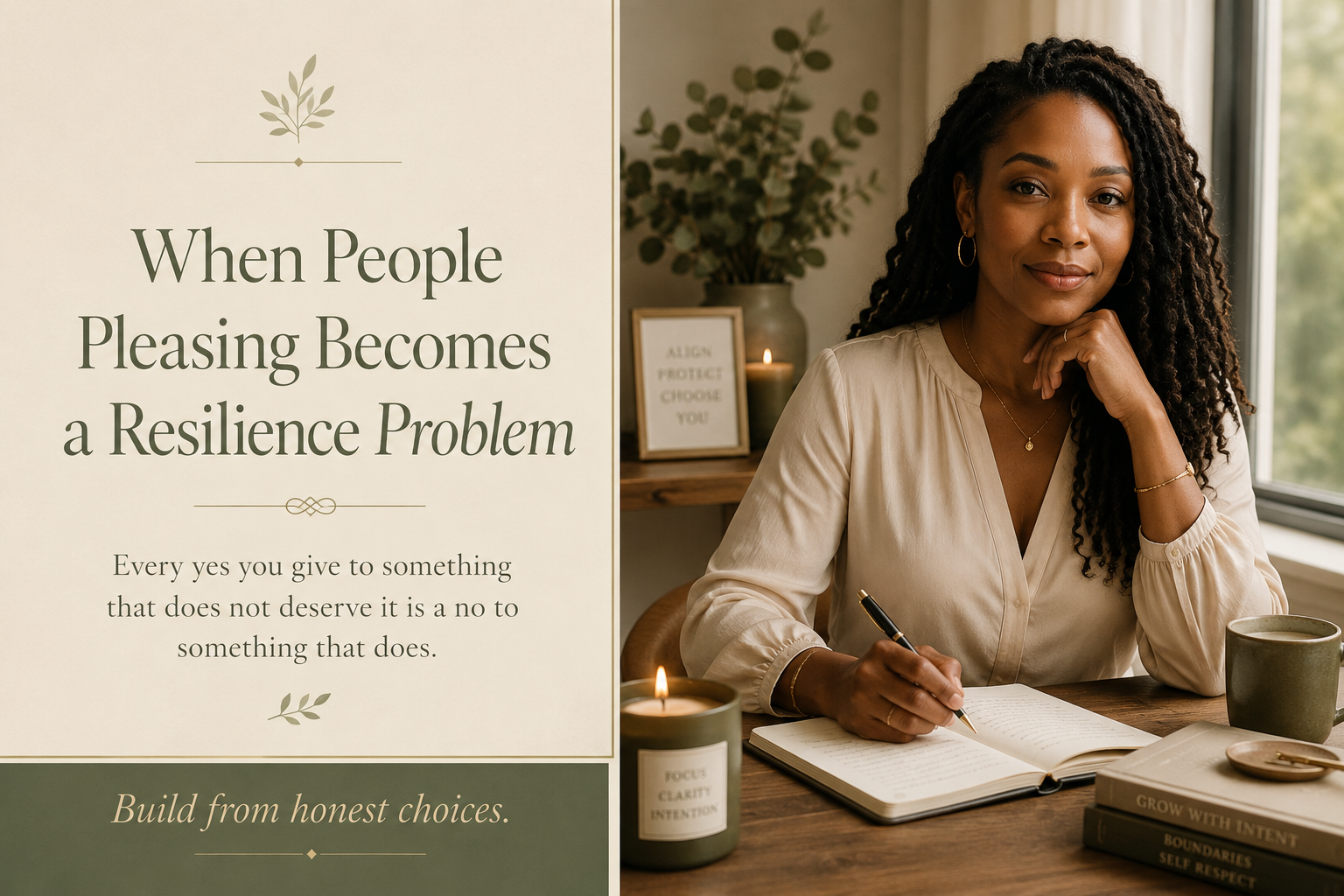
When People Pleasing Becomes a Resilience Problem
People pleasing feels like the generous choice in the moment. But over time it becomes one of the most expensive habits you can carry — not just emotionally, but structurally. Here is what it is really costing you.
Most conversations about people pleasing focus on boundaries and self worth.
And those things matter.
But there is another layer to this conversation that does not get talked about enough.
People pleasing is not just an emotional pattern. Over time it becomes a capacity problem. A resilience problem. A design problem.
Because every time you agree to something that is not aligned with what you actually want — every time you say yes to keep the peace, to avoid disappointing someone, to smooth over a moment of discomfort — you are making a withdrawal from a resource that does not replenish on its own.
And eventually the account runs dry.
What People Pleasing Actually Costs
It is easy to think of people pleasing as harmless. Polite even. The path of least resistance.
But look at what it actually requires.
It requires you to override your own instincts. To silence the part of you that knows what you want and replace it with what you think someone else needs to hear. To spend energy managing other people's reactions instead of building your own life.
That is not a small cost. That is a significant and ongoing drain on your capacity.
And unlike physical exhaustion — which is visible and easy to name — this kind of depletion is quiet. It builds slowly. It hides behind helpfulness and agreeableness and being the person everyone can count on.
Until one day you realize you have built a life full of other people's preferences and almost none of your own.
"Every time you agree to something that is not aligned with what you want, you are making a withdrawal from a resource that does not replenish on its own."
In Systems Thinking We Call This a Single Point of Failure
In Business Continuity and Disaster Recovery, a single point of failure is any place in a system where too much depends on one resource — one person, one process, one decision — with no backup and no redundancy.
When that single point fails, everything downstream fails with it.
Chronic people pleasing creates a single point of failure in your life.
Your decisions become dependent on other people's approval. Your sense of direction becomes dependent on what others want from you. Your capacity becomes dependent on having enough left over after everyone else's needs are met.
That is not a resilient system. That is a system designed to collapse under pressure.
And the pressure always comes.
Being Firm on What You Want Is Not Selfishness — It Is Design
There is a difference between being selfish and being clear.
Selfish is taking without regard for others. Clear is knowing what you need and being honest about it — even when it disappoints someone, even when it creates a moment of discomfort, even when it means holding a position that nobody else in the room agrees with.
Clarity is not unkind. It is actually one of the most respectful things you can offer the people around you.
Because when you are clear about what you want — when you stop agreeing to things you do not mean — the people in your life get the real version of you. Not the performed version. Not the version that is quietly resentful and slowly depleting. The real one.
And a relationship built on your honest yes is always stronger than one built on a yes you never meant.
The Strain Nobody Talks About
When you agree to something that is not aligned with what you want, the work does not stop at the agreement.
You still have to show up for it. You still have to deliver on it. You still have to manage the internal resistance every single time.
That resistance has a cost. Not just in time and energy — but in the quiet strain it puts on your nervous system, your relationships, and your sense of self.
Over time that strain accumulates. It shows up as irritability you cannot explain. Fatigue that rest does not fix. A growing distance between who you are performing and who you actually are.
In systems terms this is called operating under sustained load without adequate recovery. And systems that operate that way for long enough do not just slow down.
They fail.
"A relationship built on your honest yes is always stronger than one built on a yes you never meant."
What Firmness Actually Looks Like
Being firm on what you want does not mean being rigid or unkind. It does not mean never compromising or never considering others.
It means knowing your own direction clearly enough that you can tell the difference between a genuine choice and an appeasement.
It means being willing to sit in the discomfort of someone else's disappointment without immediately trying to fix it by abandoning your own position.
It means trusting that the people worth keeping in your life can handle your honest no — and that the ones who cannot are showing you something important.
Firmness is not a wall. It is a foundation. And a life built on a foundation of honest choices is a life that does not require constant recovery from the strain of living inauthentically.
A Reflection for You
Where in your life are you agreeing to things that are not aligned with what you actually want?
What decisions have you made recently to keep the peace — and what did that cost you in energy, time, or quiet resentment?
What would you do differently if you trusted that the people who matter could handle your honest answer?
Where is people pleasing showing up as a capacity drain in your life right now?
People pleasing feels like the generous choice in the moment.
But over time it becomes one of the most expensive habits you can carry.
Not just emotionally. But structurally. In the way your life gets designed. In the way your capacity gets allocated. In the distance that grows between the life you are living and the life you actually want.
Being firm on what you want is not about being difficult.
It is about being honest enough with yourself — and with others — to build something real.
And something real is always worth the temporary discomfort it takes to choose it.
— Nikki

Stop Forcing the Fit — A Aligned Life Is a Peaceful One
There is a kind of exhaustion that has nothing to do with how busy you are. It is the exhaustion of living out of alignment. This post is about what it looks like to finally stop forcing the fit — and build a life that actually feels like yours.
There is a kind of exhaustion that has nothing to do with how busy you are.
It is the exhaustion of living out of alignment.
Of spending your days in environments that do not fit. Saying yes to things that do not reflect who you are. Measuring your life against someone else's and wondering why yours feels like it is missing something.
That feeling is not a sign that something is wrong with you.
It is a sign that something around you needs to change.
Start With What Actually Has Value to You
Not what looks impressive. Not what other people think you should want. Not the version of success that gets the most likes or the most admiration in the room.
What actually has value to you.
This is where alignment begins — not with a plan or a strategy, but with an honest conversation with yourself about what matters and what does not.
When you get clear on what has value, something shifts. You stop filling your life with things that look good and start filling it with things that feel true.
Your calendar starts to reflect your actual priorities. Your energy goes toward what genuinely sustains you. And the things that were draining you quietly — the commitments, the environments, the relationships — start to become visible for what they are.
Deciding what has value is not a small thing. It is the foundation everything else gets built on.
"Peace does not come from having everything figured out. It comes from knowing yourself well enough to stop pretending."
Stop Forcing What No Longer Fits
There is a version of you that made certain choices — joined certain groups, pursued certain goals, built certain habits — based on who you were at the time.
And that version of you was doing the best they could with what they knew.
But growth does not freeze just because the decisions were already made.
Sometimes you outgrow environments. Sometimes you outgrow goals. Sometimes you outgrow the version of yourself that needed a certain kind of validation or belonging.
And when that happens the most honest thing you can do is stop forcing the fit.
Forcing what is not aligned is not loyalty. It is not commitment. It is not strength.
It is the slow erosion of the truest version of yourself — the one you are still becoming.
You Are Not Who You Were — And That Is the Point
Alignment is not a fixed destination. It is a living, shifting relationship between who you are today and how you are choosing to live.
The question worth asking regularly is not who you used to be or who others expect you to be.
It is who you are right now — and where you are aligning yourself to be your highest self.
That question changes things. It gives you permission to let go of what no longer serves the person you are growing into. It reminds you that changing direction is not failure — it is discernment.
And discernment only comes from knowing yourself well enough to tell the difference between what fits and what you have just gotten used to.
Peace Comes From Knowing Yourself
Real peace — the kind that does not depend on everything going right — comes from one place.
Knowing yourself. And being true to that.
Not the version of yourself that performs for approval. Not the version that shrinks to fit the room. Not the version that keeps showing up to environments that require you to be less than you are.
The version that knows what matters. That knows what aligns. That knows when something feels off — and trusts that feeling enough to do something about it.
That kind of self knowledge is not built overnight. It is built in the quiet moments. The honest ones. The ones where you stop long enough to actually hear yourself.
And when you have it — when you know yourself clearly — the noise of comparison, expectation, and external pressure loses most of its power.
"There is only one you. And you are the only one in charge of shaping what that life looks like."
Stop Comparing Your Life to Someone Else's
Comparison is one of the quietest ways we abandon ourselves.
It pulls attention away from your own path and fixes it on someone else's. It measures your behind the scenes against their highlight reel. It whispers that you are behind, that you are less than, that you should be further along by now.
But here is what comparison always misses.
There is only one you. With your specific combination of experiences, values, gifts, and vision. Nobody else is building what you are building. Nobody else is walking the path you are walking.
Your life does not need to look like anyone else's to be valid. It does not need to follow someone else's timeline to be meaningful. It does not need external comparison to determine its worth.
You are the one in charge of shaping what your life looks like. That is not a burden. That is one of the most powerful things you have.
If the Environment Does Not Fit — Change It
Sometimes alignment requires an external shift.
Not every environment is designed to support who you are becoming. Some spaces were built for a version of you that no longer exists. Some groups, some circles, some towns — they made sense at one point. They no longer do.
And that is okay.
Changing your environment is not running away. It is not being difficult. It is not ingratitude.
It is one of the most honest acts of self respect available to you.
Sometimes the change looks like no longer attending the group meetup that drains you every time. Sometimes it looks like stepping back from a circle that requires you to perform instead of belong. And sometimes — when your spirit has been quietly asking for it for longer than you want to admit — it looks like moving to a place that actually aligns with who you are.
Only you know which change is needed. Only you can hear that signal clearly enough to act on it.
A Reflection for You
What in your life right now actually has value to you — and what are you holding onto out of habit or expectation?
Where are you forcing a fit that stopped feeling right a long time ago?
What environment, group, or commitment has been quietly draining you — and what would it feel like to let it go?
What does your highest self look like — and how much of your daily life is actually aligned with that version of you?
Alignment is not a luxury. It is not something to figure out after everything else is handled.
It is the work.
Because a life built around what actually has value — around who you actually are, not who you have been performing — is a life that does not require constant recovery.
It is a life that feels like yours.
And that kind of peace is worth every honest, uncomfortable, necessary choice it takes to get there.