
Notes on Resilience & Aligned Living
Reflections on clarity, capacity, transition, and building systems — personal and professional — that don’t collapse under pressure.
This is where lived experience meets structured resilience thinking.
Where I connect the dots between:
• Corporate resilience
• Personal capacity
• Burnout and rebuilding
• Structure and softness
• Designing a life that works anywhere
Because resilience is not theoretical. It is lived.
While my advisory work strengthens organizations behind the scenes, this space holds the human side of resilience.
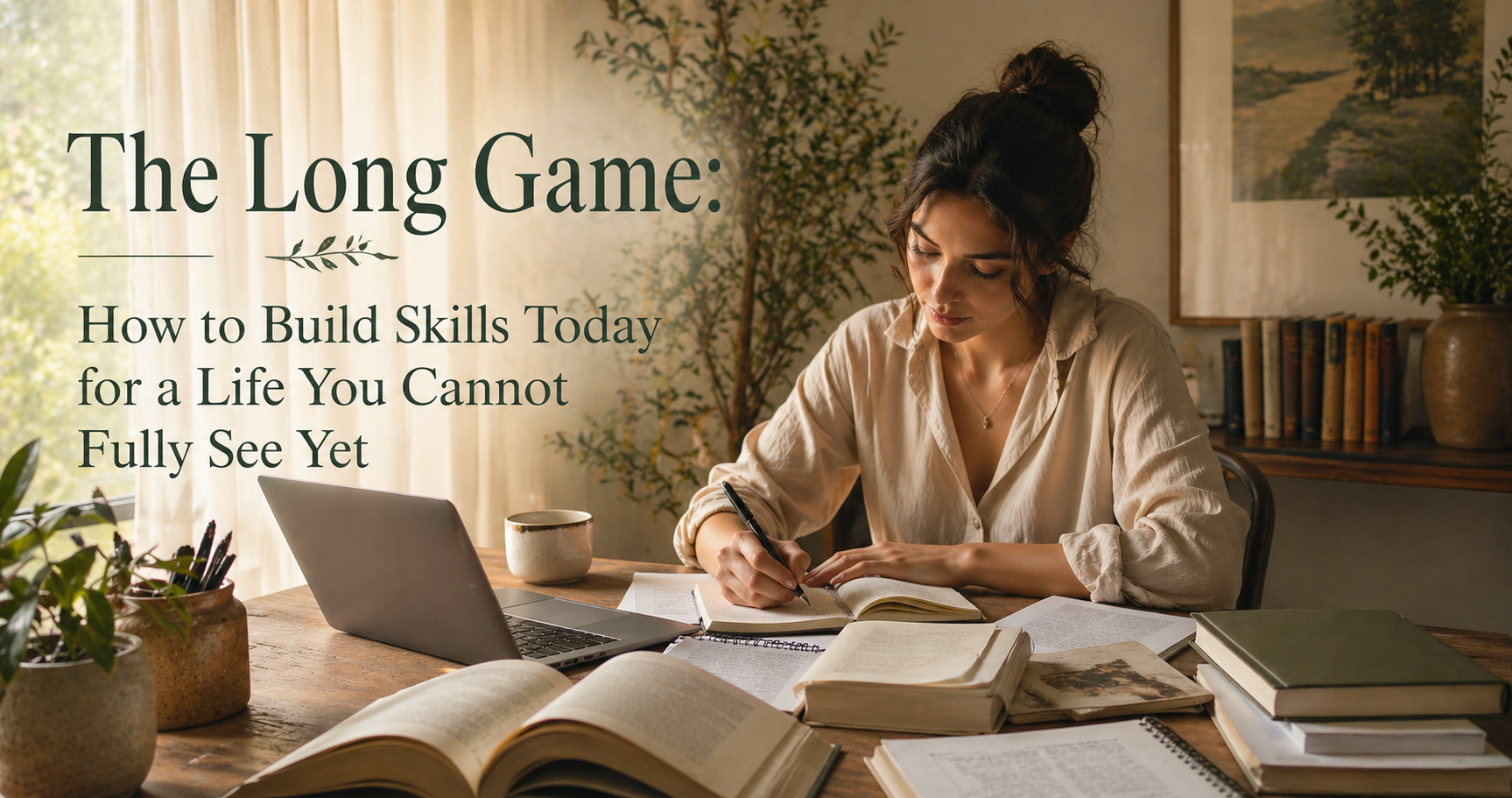
The Long Game: How to Build Skills Today for a Life You Cannot Fully See Yet
There is a particular kind of discomfort that comes from building something you cannot fully see yet. That discomfort is not a warning sign. It is what the long game feels like from the inside.
There is a particular kind of discomfort that comes from building something you cannot fully see yet.
You are adding skills. Taking courses. Earning certifications. Saying yes to opportunities that do not quite connect — at least not on the surface. And somewhere in the back of your mind a quiet voice asks whether any of it is actually leading somewhere.
That discomfort is not a warning sign.
It is what the long game feels like from the inside.
You Do Not Need a Clear Destination to Start Building
One of the biggest reasons people delay investing in themselves is because they cannot see the full picture yet.
They do not know exactly what they want. They are not sure which direction they are heading. They are waiting for clarity before they commit to building anything.
But clarity rarely comes before the building. It comes during it.
The skills you develop today — even the ones that feel uncertain or loosely connected — are creating options for a version of your life you cannot fully see yet. And options are what make a life resilient.
You do not need to know the destination to start preparing for the journey.
"Clarity rarely comes before the building. It comes during it."
In Business Continuity We Build Before the Crisis
In Business Continuity and Disaster Recovery, one of the core principles is this — you do not wait for disruption to build your recovery plan.
You build it before anything goes wrong. You identify what you would need. You develop the capabilities that allow you to recover quickly. You create redundancy and options before they are urgently needed.
That same principle applies to your life.
Building skills today — before you desperately need them, before the market shifts, before life changes in ways you did not plan for — is not overpreparation.
It is strategic resilience.
The people who navigate disruption most effectively are almost never the ones who started preparing after things changed. They are the ones who were already building.
Skills Compound the Same Way Interest Does
There is something that happens when you commit to building consistently over time.
The skills stack. They connect. They start to create combinations that nobody else has — because nobody else has lived your specific journey or made your specific choices about what to develop.
A skill you build today may not be immediately useful. It may sit quietly in the background for months or even years before it becomes exactly what a moment requires.
But it is never wasted.
Every capability you develop adds to the ecosystem of who you are becoming. And ecosystems — unlike single streams — can survive almost anything.
What the Long Game Actually Looks Like
It does not look dramatic. It rarely feels significant in the moment.
It looks like reading in an area outside your current role because something about it interests you.
It looks like taking a course not because it is immediately required but because it expands how you think.
It looks like volunteering for the project that stretches you even when it would be easier to stay comfortable.
It looks like writing, creating, building something — even when the audience is small and the return is not yet visible.
It looks like developing your communication, your emotional intelligence, your ability to think across disciplines — not because someone asked you to but because you understand that range creates resilience.
None of those things feel like a long game in the moment. They feel like small choices.
But small choices made consistently over time become the foundation of a life that can absorb almost anything.
"The skills you build before you need them are the ones that give you options when everything changes."
Stop Waiting for the Vision to Be Complete
The vision you have today is incomplete by design. It is supposed to be. Because the version of you that will inhabit that future life is still being shaped by everything you are doing right now.
The clearer you get on your values — what matters, what aligns, what sustains you — the more naturally your skill building will point in the right direction.
You do not need the full map. You need the next right layer.
What skill, if developed consistently over the next six months, would give you more options?
What capability, if built quietly and steadily, would make you harder to disrupt?
What area of growth, if invested in now, would the future version of you be grateful for?
Start there. The picture will fill in as you build.
The Skills Nobody Can Take From You
There is a particular kind of security that comes from skills that are portable, internal, and not dependent on any single employer, industry, or system.
The ability to think critically and solve problems under pressure.
The ability to communicate clearly across different audiences.
The ability to learn quickly when conditions change.
The ability to lead — yourself first, and then others.
The ability to build something from nothing when the opportunity presents itself.
These are not narrow skills tied to one role or one organization. They travel with you. They apply across contexts. They become more valuable over time, not less.
Building them is not just professional development. It is personal infrastructure.
A Reflection for You
What skill have you been meaning to develop but keep waiting for the right time to start?
What capability, if you had it today, would give you more confidence about the future?
What are you genuinely curious about — not just strategically curious — that might be worth following?
Where are you playing it safe in your development when you could be building range?
Playing the long game is not about having all the answers today.
It is about making consistent investments in yourself — quietly, steadily, intentionally — before life demands that you have them.
The life you cannot fully see yet is being shaped right now. Not by what you are waiting for. By what you are building.
Start building.
— Nikki
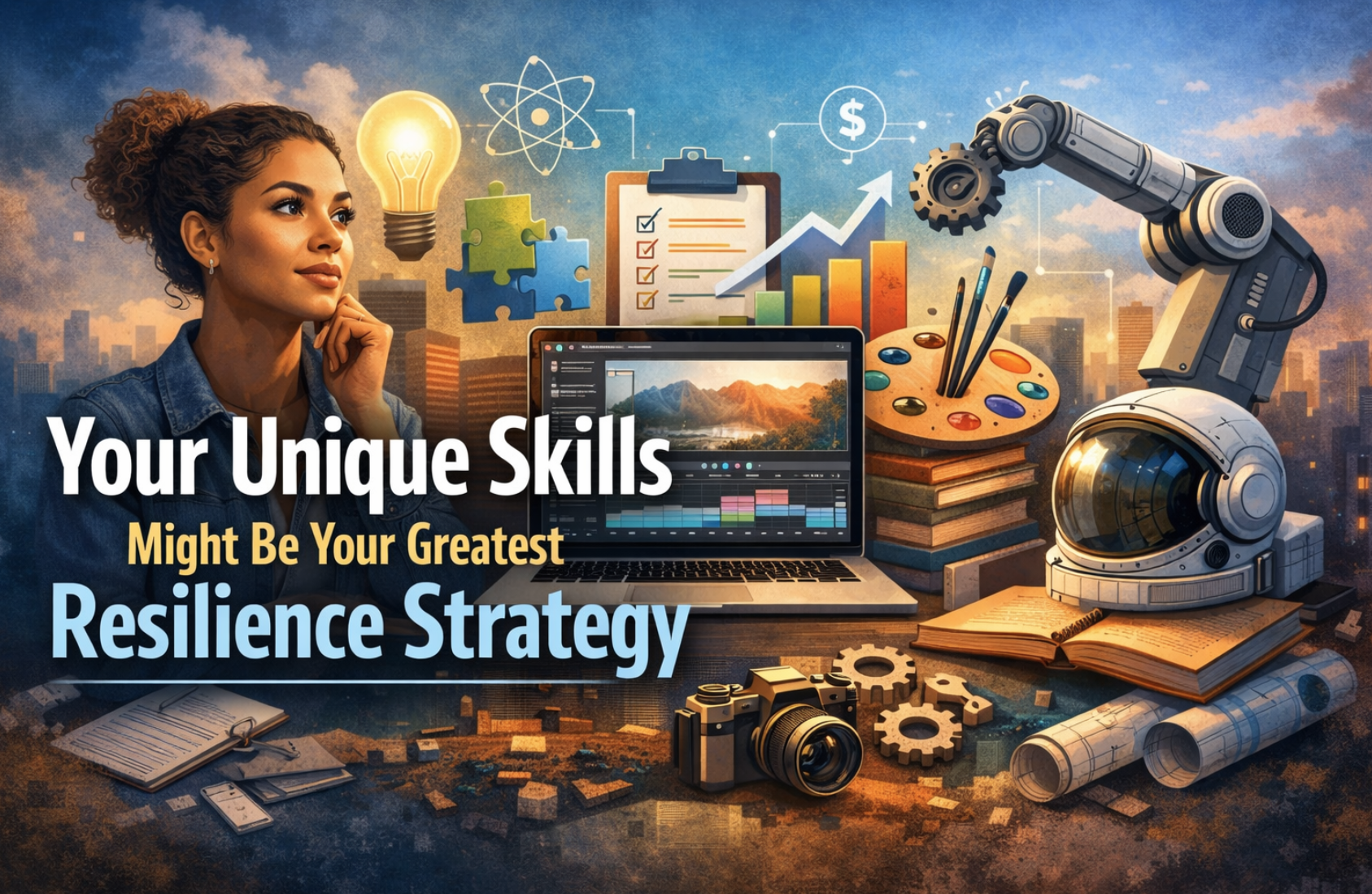
Your Unique Skills Might Be Your Greatest Resilience Strategy
Resilience is not just about toughness. It is about range. The unique skills you have picked up across your life — the ones that never quite fit one job description — may be your most powerful resilience strategy yet.
Here is a quiet misconception about resilience that is worth addressing.
Most people think resilience is about toughness. About gritting your teeth and pushing through. About being the person who never breaks.
But real resilience is rarely about toughness alone.
More often it comes from something much more practical — range.
The more ways you can think, adapt, and contribute, the more resilient your life becomes. And this is where something important often gets overlooked.
Your unique skills are not just interesting. They may be your most powerful resilience strategy.
Not Just Your Profession — Everything You Have Picked Up Along the Way
Think beyond your job title for a moment.
Think about the things you learned out of pure curiosity. The hobbies you developed without ever thinking about monetizing them. The talents that never quite fit neatly into one job description but kept showing up anyway.
Those skills matter more than most people realize.
They are not random. They are not unrelated. Together they form a collection of capabilities that makes you adaptable in ways a single specialty never could.
And in uncertain times — economically, professionally, personally — adaptability is everything.
"When your identity depends on only one role or one skill set, change becomes threatening. When you have range, change becomes something you can navigate."
Why Range Creates Resilience
People who can combine multiple capabilities adapt faster. It is not a coincidence — it is how resilience actually works in practice.
Someone who understands technology and communication can move between industries without starting from scratch.
Someone who can analyze systems and explain them clearly becomes valuable in almost any organization.
Someone with creative ability and strategic thinking can build opportunities where none existed before.
This is sometimes called skill stacking. But at a deeper level it is really about resilience.
In Business Continuity and Disaster Recovery, we build redundancy into systems on purpose. No single point of failure. Multiple pathways to the same outcome. When one route closes another is already available.
Your skill range works the same way. When change comes — and it always does — range is what allows you to pivot instead of collapse. You do not have to start over. You move sideways, forward, diagonally — because you have more than one direction available to you.
Options are one of the strongest forms of resilience you can build.
The Most Valuable People Are Rarely the Ones With One Deep Specialty
They are the ones who can connect multiple disciplines in a way others cannot.
Someone who understands operations and strategy can identify risks others overlook entirely.
Someone with creative ability and business awareness can see opportunities others never considered.
Someone who bridges communication and technical knowledge becomes the person every room needs.
Resilience often lives in the intersection of skills — not at the top of one single ladder.
The things that once felt unrelated may eventually become the most distinctive thing about you. The combination that nobody else has. The perspective that only comes from having lived and learned across more than one lane.
"Resilience often lives in the intersection of skills — not at the top of one single ladder."
Adaptability Is the Real Advantage
Resilience is not only about endurance. It is also about adaptability.
And adaptability almost always comes from the range of capabilities built over time — not just the depth of one.
The hobbies. The side interests. The skills that felt like detours. None of that was wasted.
Together they created something powerful. They created options.
And a life with options is a life that can absorb change without breaking.
A Reflection for You
What skills have you developed outside of your main career — and are you giving them credit?
What problems do people consistently ask for your help with, even informally?
What abilities feel natural to you but genuinely valuable to others?
What combinations of skills make your perspective different from everyone else in the room?
Your resilience strategy may already be present in the skills you have been quietly developing all along. You just have not called it that yet.
Your unique skills may not follow a traditional path. They may not fit neatly into one job title or one lane.
But together — the curiosity, the range, the seemingly unrelated capabilities — they create something that a single specialty never could.
They create flexibility. They create options. They create a life that does not depend on everything staying the same to stay intact.
That is not a detour. That is your strategy.